
3 days and it’s time to celebrate America!

Tahoma Specialty Pest Services
Pest and Wildlife Control for Residential and Commercial Clients in the Spokane, and Inland Northwest Region
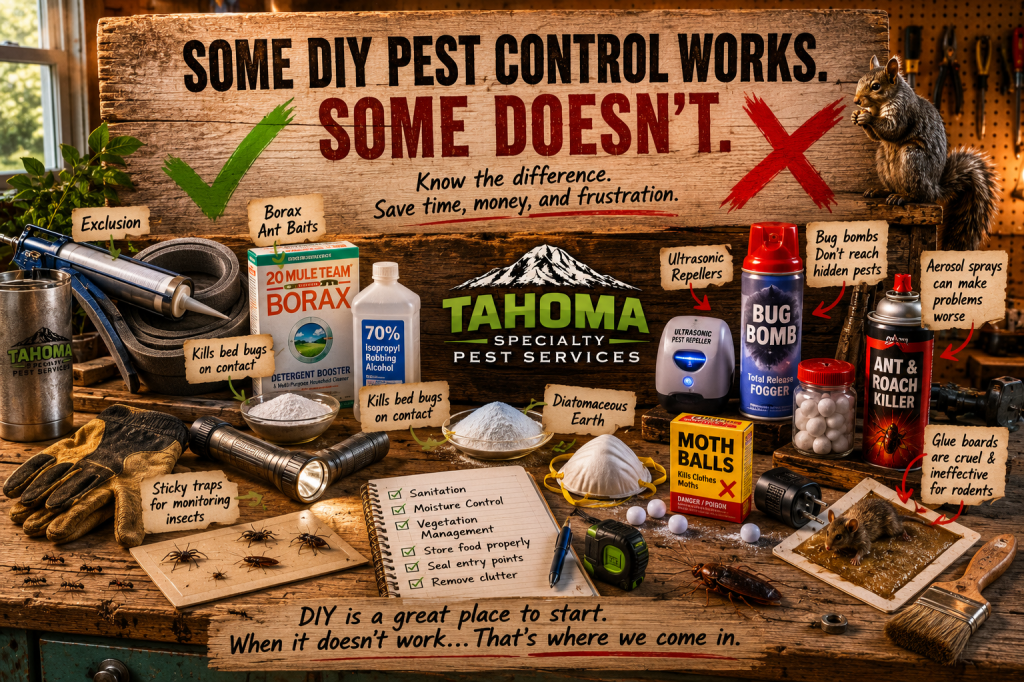
The honest answer is… sometimes.
There are quite a few do-it-yourself pest control methods that genuinely work when they’re used correctly. There are also plenty that waste your time, and a few that can actually make the problem worse.
Here’s a look at some of the more common ones.
Borax Ant Baits
For some ant species, a properly prepared borax bait mixed with a food source can be effective. The workers carry the bait back to the colony, helping reduce the population over time.
The key is using the correct concentration. Too much borax can repel ants before they have a chance to share the bait with the rest of the colony.
Rubbing Alcohol for Bed Bugs
Rubbing alcohol kills bed bugs on contact.
If you see a bug while inspecting furniture or bedding, alcohol is one of the few household products I actually recommend using.
Just remember—it only kills what it directly touches. It won’t eliminate an infestation hiding in walls, furniture, or other inaccessible areas.
Diatomaceous Earth
Diatomaceous earth is a desiccant, meaning it damages an insect’s protective outer layer and causes it to dry out.
It absolutely works.
However, it’s often misused.
Because it’s a very fine powder, it becomes airborne easily. Breathing large amounts of dust isn’t good for people or animals, so avoid broadcasting it throughout living spaces.
When used, I recommend applying it only in enclosed voids, wall cavities, crawlspaces, or other locations where it won’t become airborne during normal activity.
It also has legitimate uses around poultry, where properly managed dust baths can help reduce certain external parasites.
Sticky Traps
Sticky traps are excellent monitoring tools for insects such as spiders, cockroaches, and crawling insects.
They help identify where activity is occurring and whether a treatment is working.
I do not recommend glue boards for rodent control. They are generally inhumane and often catch only juvenile mice while leaving the real problem unresolved.
Flea Foggers
Foggers can reduce adult flea populations and may provide temporary relief.
Unfortunately, they often fail to kill eggs hidden deep in carpet fibers or protected areas, which means the infestation usually returns unless additional treatment is performed.
Mothballs
Mothballs contain a strong fumigant and are designed for use in sealed containers to protect clothing from fabric pests.
People often try using them for mice, snakes, raccoons, and other wildlife.
While the odor can occasionally encourage an animal to leave a confined hiding place, they are not labeled for general wildlife control and should never be used throughout occupied living spaces.
Ultrasonic Pest Repellers
Despite their popularity, I have never found these devices to provide reliable pest control.
If they truly worked as advertised, the pest control industry would be using them everywhere.
Peppermint Oil, Dryer Sheets & Soap Bars
These are some of the most common recommendations you’ll find online.
While strong odors may temporarily discourage an animal or insect from using a particular spot, they rarely solve the underlying problem and almost never eliminate an infestation.
Aerosol Ant Sprays
This surprises many homeowners.
For certain species, particularly odorous house ants, spraying visible workers can cause the colony to split into multiple smaller colonies, making the infestation even harder to eliminate.
Sometimes spraying creates more ants—not fewer.
Consumer Bed Bug Sprays
Most over-the-counter bed bug products simply don’t eliminate established infestations.
Even worse, they can scatter bed bugs into new hiding places, making professional treatment more difficult later.
Bug Bombs for Bed Bugs
This is probably one of the biggest misconceptions in pest control.
People often assume bed bugs can be treated the same way as fleas because both feed on blood.
They can’t.
Bug bombs rarely reach where bed bugs actually hide and often cause them to disperse deeper into walls, furniture, and other protected areas.
I actually encourage homeowners to start with simple, practical solutions when they’re appropriate.
Good sanitation, sealing entry points, reducing moisture, trimming vegetation, and using the right DIY products can solve many small pest issues before they become major problems.
But when those methods stop working—or start making the problem worse—that’s usually a sign the issue has grown beyond what a do-it-yourself approach can solve.
That’s where experience, proper products, and a thorough inspection make all the difference.
At Tahoma Specialty Pest Services, my goal isn’t just to treat pests—it’s to solve the problem that’s allowing them to be there in the first place.
Tahoma Specialty Pest Services
tahomapest.com / 509 978 7830

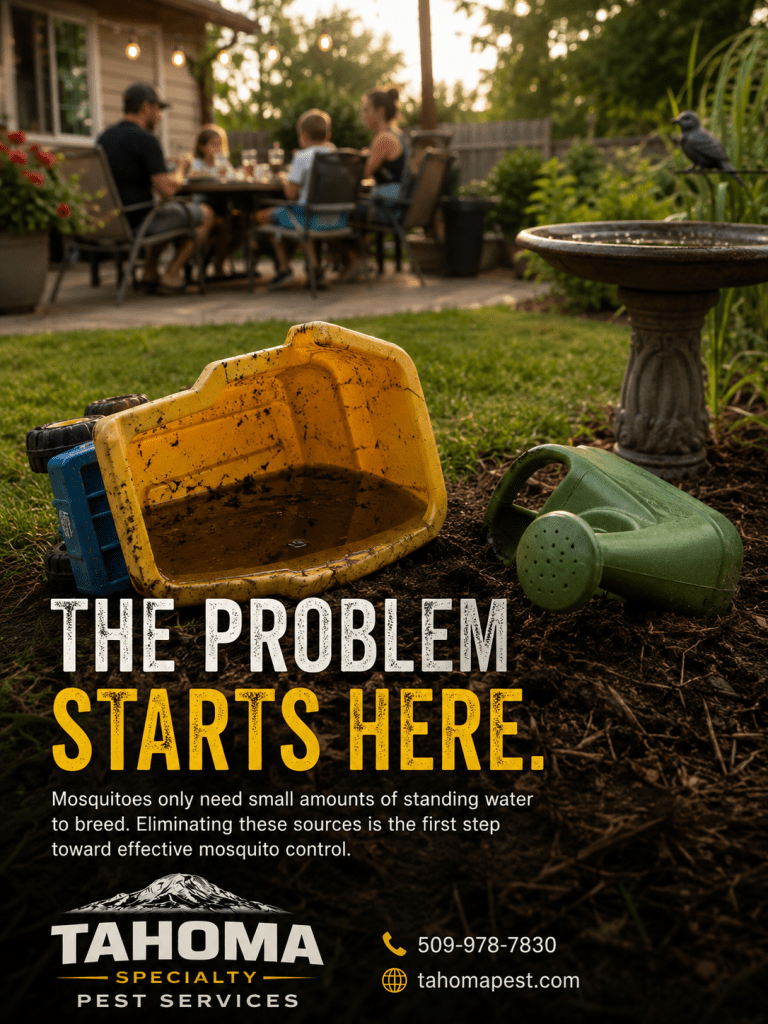
Mosquitoes are one of the most recognizable summer pests, but surprisingly, the best mosquito treatment often begins long before any product is applied.
It starts with an inspection.
Mosquitoes need standing water to complete their life cycle. Even small amounts of water can become breeding sites, which is why identifying and eliminating those sources is one of the most effective long-term control strategies.
Some of the most common breeding areas include:
buckets, pails, and watering cans
flower pots and saucers
children’s toys left outdoors
old tires
bird baths
clogged gutters
abandoned or poorly maintained swimming pools
low spots where water collects after irrigation or rain
overwatered lawns and landscaping
By reducing these breeding sites, you often reduce mosquito numbers before they become a larger problem.
When treatment is needed, the approach depends on the property and the level of mosquito activity.
Treatment options may include:
targeted fogging of vegetation and outdoor living spaces
residual applications to shaded resting areas where adult mosquitoes spend the day
larvicide treatments for standing water that cannot be eliminated
treatment plans tailored to the property’s conditions and your goals
Like most pest issues, successful mosquito control is rarely about one application. It’s about combining inspection, habitat management, and targeted treatment to reduce the mosquito population over time.
Tahoma Specialty Pest Services
509-978-7830
tahomapest.com
Ground squirrels are a common sight throughout Eastern Washington, especially around agricultural properties, pastures, hay fields, and rural acreages.
While many people see them as harmless wildlife, large populations can create significant problems for both property owners and livestock.
The most obvious issue is burrowing.
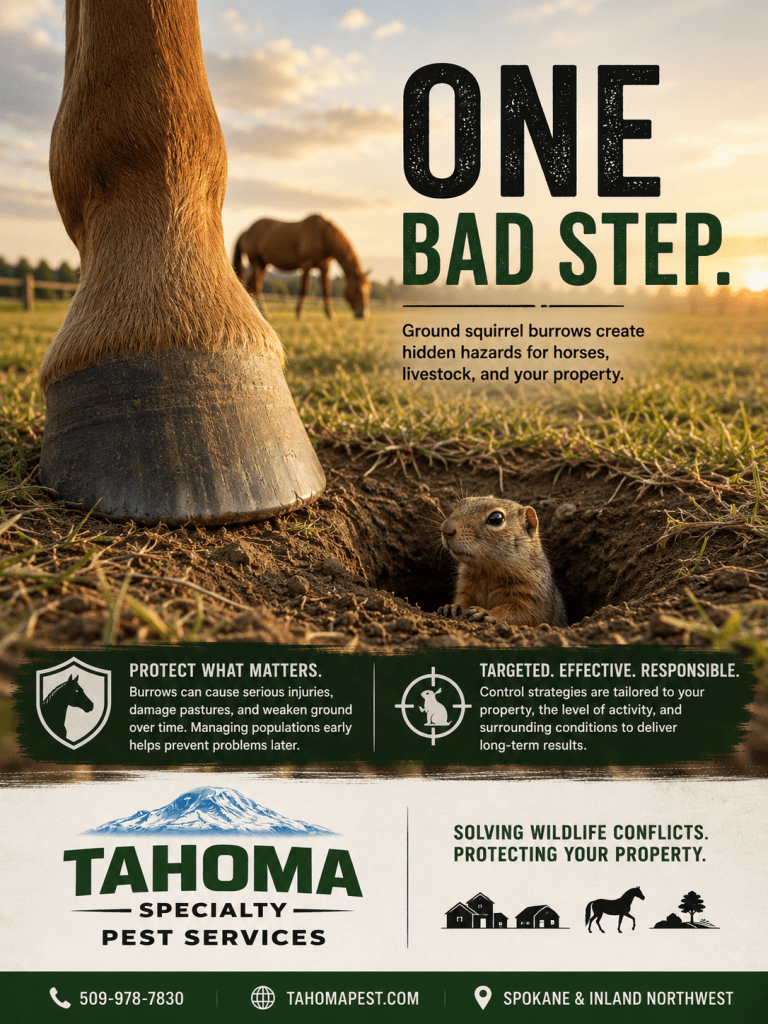
Ground squirrels create extensive tunnel systems that weaken soil and leave holes throughout fields, pastures, and grassy areas. For horse owners, these burrows can be especially concerning. A missed hole in a pasture can create a serious injury risk if a horse steps into it while running or playing.
Ground squirrels can also contribute to:
damage to pastures and forage areas
loss of desirable vegetation
soil erosion around burrow systems
damage to irrigation and agricultural infrastructure
increased attraction of predators and scavengers
Like many wildlife issues, small populations can quickly become large populations if left unmanaged.
Effective control depends on the property, the surrounding environment, and the presence of non-target wildlife. Management strategies may include population reduction, burrow monitoring, habitat considerations, and ongoing maintenance to keep numbers under control.
The goal isn’t simply removing animals. It’s protecting the property, livestock, and resources that are being impacted by their activity.
Tahoma Specialty Pest Services
509-978-7830
tahomapest.com
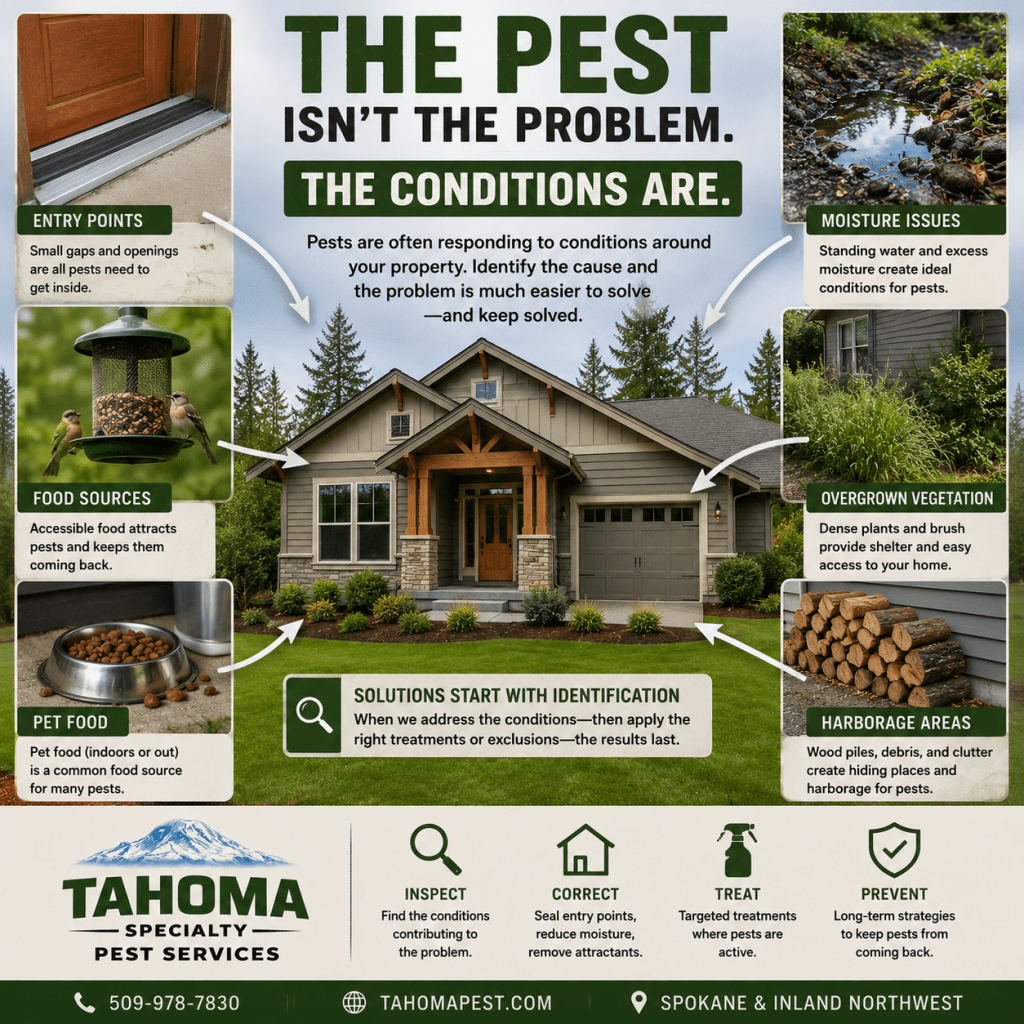
One of the most common misconceptions about pest control is that the pest itself is always the problem.
In reality, many pest issues are symptoms of something else.
Ants may indicate a moisture issue, food source, or structural condition that’s attracting them.
Spiders are often a sign that other insects are present.
Rodents usually don’t appear by accident. They’re finding food, water, shelter, or an easy way inside.
Even nuisance wildlife is often responding to conditions around a property. Accessible garbage, pet food, bird seed, damaged vents, and unsealed entry points can all contribute to ongoing conflicts.
That’s why effective pest management isn’t just about applying products or setting traps.
It’s about understanding why the pest is there in the first place.
When I inspect a property, I’m looking for the conditions contributing to the problem:
-entry points
-moisture issues
-food sources
-harborage areas
-structural deficiencies
-landscaping concerns
Sometimes treatment is part of the solution.
Sometimes exclusion is the solution.
Sometimes a simple change in conditions solves the problem entirely.
The goal isn’t just removing what’s there today.
The goal is preventing the problem from coming back tomorrow.
Tahoma Specialty Pest Services
509-978-7830
tahomapest.com

Informative, fun, and educational posts will be back again next week.
We will not be open during the Memorial Day Weekend.
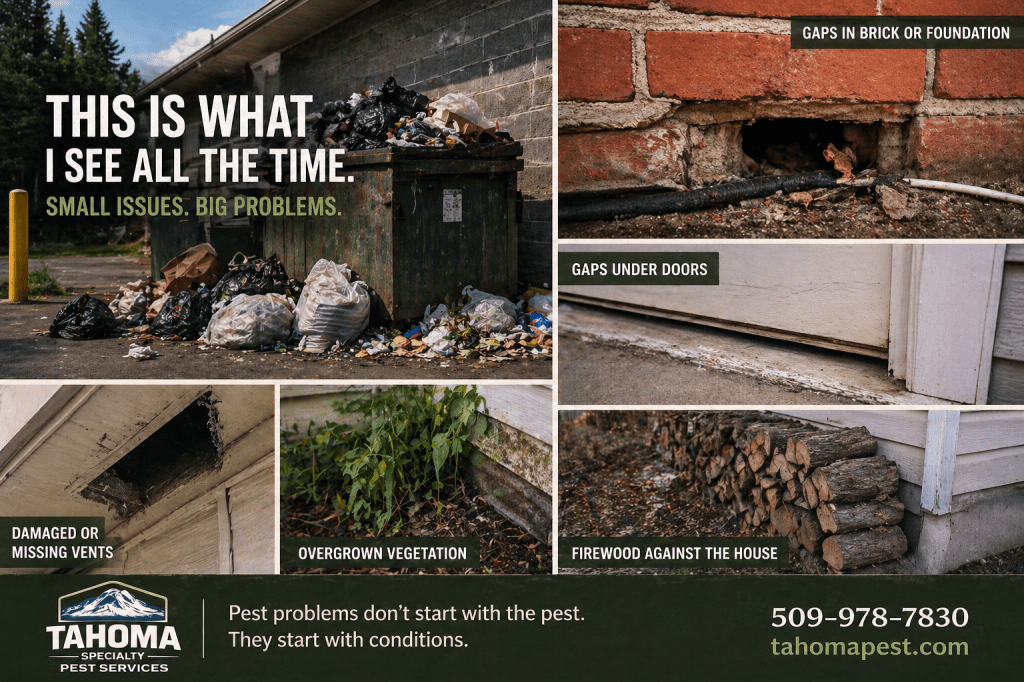
This is what I see all the time.
Small gaps, overlooked openings, and conditions that don’t seem like a big deal at first glance.
A gap under a door.
A break in the foundation.
An opening around the structure.
These are the kinds of things that allow pests and wildlife to get in.
Most of the time, the issue isn’t complicated — it’s just something that went unnoticed.
Once that opening exists, it becomes an easy access point.
From there, the problem develops.
That’s why I spend a lot of time looking at the structure itself.
Not just what’s inside — but how it got there in the first place.
Because if the access point isn’t addressed, the problem usually comes back.
Tahoma Specialty Pest Services
509-978-7830
tahomapest.com

A common question is whether wildlife can simply be trapped and relocated somewhere else.
It sounds like a straightforward solution—but in most cases, it’s not allowed, and it’s not effective.
In Washington, relocating wildlife is heavily regulated. Outside of very specific situations (such as certain beaver relocations under proper permitting), both the public and licensed operators are generally not allowed to trap and relocate animals to a new area.
There are good reasons for this.
Most wildlife is territorial. Moving an animal into a new area often puts it into conflict with others already established there.
Survival rates after relocation are also low. Animals depend on familiar food sources, shelter, and travel patterns. When moved, they often struggle to adapt.
Because of this, relocation is usually not the responsible solution.
In most cases, the options are limited to:
releasing the animal on-site (when appropriate), or
resolving the issue in a way that addresses the problem directly
That’s why the focus of professional wildlife control isn’t just on the animal—it’s on the conflict.
As I often tell customers:
“My job is to eliminate conflicts, not necessarily eliminate critters.”
That can involve identifying how the animal is accessing the area, correcting conditions that are attracting it, or using techniques like harassment and hazing to encourage it to move on.
Not every situation requires removal, and not every job should be done. In some cases, the right approach is simply understanding what’s happening and letting wildlife be.
Tahoma Specialty Pest Services takes a practical, conservation-minded approach—focused on solving problems while respecting the role wildlife plays in the environment.
Tahoma Specialty Pest Services
509-978-7830
tahomapest.com

