
No work today. Tahoma Specialty Pest Services will be closed for Labor Day. We will be back to bust’n bugs tomorrow.
509-978-7830 / tahomapest.com
#Spokane #laborday #endofsummer

Pest and Wildlife Control for Residential and Commercial Clients in the Spokane, and Inland Northwest Region
No work today. Tahoma Specialty Pest Services will be closed for Labor Day. We will be back to bust’n bugs tomorrow.
509-978-7830 / tahomapest.com
#Spokane #laborday #endofsummer

Wildfire changes a landscape in ways that don’t end when the flames are out.
We understandably think first about the people, homes, businesses, and communities affected by fire. But the same landscape was also home to countless wild animals—and when that habitat changes, wildlife has to adapt.
After the amount of ground that has burned around our region this summer, that’s something homeowners in and around affected areas may begin noticing.
And with fall approaching—a time when many animals are already moving around and looking for food and shelter—we may see wildlife activity in some unusual places.
This is an important distinction.
A wildfire doesn’t suddenly create more mice, marmots, squirrels, skunks, raccoons, snakes, or other wildlife.
Instead, fire can remove or alter the things those animals depended upon: cover, food, water, nesting areas and denning locations.
Some animals survive within the burned area. Some leave during the fire and eventually return. Others may move into neighboring areas looking for suitable habitat.
That means properties outside the actual burn area may notice changes too.
If your neighborhood borders thousands of acres of recently burned habitat, wildlife doesn’t recognize your property line. An irrigated lawn, garden, outbuilding, rock wall, deck, crawlspace, woodpile, bird feeder or source of water may suddenly be much more attractive than it was before.
Imagine a rural home that has stood for decades without significant wildlife problems.
There were always better options around it.
Plenty of natural cover. Plenty of places to den. Plenty of food and water.
Now imagine much of that surrounding habitat has burned while the house and immediate property remain intact.
Nothing about the house changed.
Everything around it did.
That doesn’t mean wildlife is inevitably going to move into the structure. But it does mean a vulnerability that never mattered before might matter now.
A damaged crawlspace vent.
A gap beneath a deck.
An opening beneath a shed.
A loose section of siding.
A hole beneath a concrete slab.
An accessible attic or roof opening.
Those conditions may have existed for years without causing a problem simply because nothing had much reason to use them.
Changing the surrounding habitat can change that equation.
This is equally important.
Not every animal that appears on your property needs to be trapped.
If you’ve never seen a particular animal in your yard before and suddenly one walks through, that doesn’t necessarily make it a nuisance animal.
It may simply be passing through.
Give wildlife space. Keep pets away from unfamiliar animals. Don’t leave food out for them, and don’t attempt to capture an animal simply because it showed up somewhere unexpected.
There’s an important difference between wildlife on your property and wildlife causing a problem on your property.
An animal passing through the backyard is one thing.
An animal establishing a den beneath your foundation, entering the crawlspace, damaging the structure, or repeatedly returning because it has found a dependable food source is another.
That’s when intervention may become appropriate.
For properties near affected areas, one of the best things you can do right now is simply take a look around.
Check crawlspace vents and access doors.
Look beneath decks, sheds and outbuildings.
Watch for new excavation around foundations and concrete.
Look for openings around the roofline.
Secure garbage, pet food, chicken feed and birdseed.
Pick up fallen fruit and eliminate unnecessary food sources.
Pay attention to new tracks, droppings, digging or other signs of activity.
You don’t need to turn your home into a fortress.
You just need to recognize that conditions around it may have changed.
Wildlife control doesn’t always need to begin with traps.
Tahoma Specialty Pest Services also provides wildlife inspections and consultations.
If you’re near a burned area and aren’t sure whether your property has vulnerabilities, I can inspect the structure and surrounding property, identify potential entry points or attractants, and help determine whether anything actually needs to be done.
Sometimes I’ll find something that should be corrected.
Sometimes the recommendation may simply be to keep an eye on an area.
And sometimes I’ll tell you there’s nothing worth worrying about.
The point of an inspection isn’t to find something I can sell you.
It’s to find out whether there’s actually a problem—or a realistic opportunity for one to develop.
Wildfire can change insect activity too, although not always in the ways people might expect.
Some insects are displaced or decline after a fire, while others actually specialize in recently burned or fire-damaged habitat. Certain wood-boring beetles, for example, can locate stressed and freshly burned trees using smoke-related chemical cues—and some fire-associated beetles can even detect infrared radiation from fires.
It’s fascinating biology, but it doesn’t mean a wave of insects is necessarily headed for nearby homes.
The more useful takeaway is simply that fire changes the entire ecosystem, and insect activity and pressure can change along with everything else.
The amount of land burned around our region this year has been significant, and we’re probably going to be seeing some of the ecological effects for quite a while.
Some wildlife will return to burned areas.
Some will establish themselves somewhere else.
Some may show up in places where homeowners have rarely—or never—seen them before.
Most of those encounters won’t require pest control.
But when wildlife begins using a home or structure for shelter, knowing about vulnerabilities before an animal establishes itself can make the situation considerably easier to manage.
So if you live near one of this year’s burned areas, don’t panic about every critter that wanders through your yard.
Just pay attention.
Their neighborhood changed too.
Tahoma Specialty Pest Services
Spokane & the Inland Northwest
509-978-7830
tahomapest.com
#Spokane #SpokaneWA #spokanefire #Wildfire #Wildlife #WildlifeControl #WildlifeAwareness #HomeownerTips #Spokanecomplexfire #oldtrailsfire #fairviewfire #autumnlanefire

I work in pest control. Obviously, I want people to hire pest control companies.
But I don’t think anyone should be pressured, frightened, or talked into buying a service they don’t actually need.
Unfortunately, there are some practices in this industry that I don’t particularly like.
One of the biggest is high-pressure door-to-door sales.
Someone knocks on your door, tells you they’re already treating several of your neighbors, points out a spider web or a couple of wasps, and suddenly you’re being told your home has a pest problem that needs to be addressed immediately.
Before you know it, there’s a tablet in front of you and you’re signing up for months—or sometimes longer—of recurring service.
Maybe you really do need pest control.
But you should have enough information to make that decision for yourself.
Door-to-Door Sales Deserve Extra Scrutiny
There’s nothing inherently wrong with someone knocking on a door and offering a legitimate service.
But you should never feel like you have to make a decision while they’re standing on your porch.
Be especially cautious when the conversation relies on urgency or fear:
-“We’re treating your neighbor because there’s a serious problem in this area.”
-“If you don’t treat this now, it’s going to get much worse.”
-“I can only give you this price if you sign up today.”
Those are sales techniques.
They aren’t a pest inspection.
A pest professional should be able to explain what the problem is, why it matters, and why a particular treatment is being recommended.
And you should be able to ask questions.
-Ask Who Is Actually Doing the Work
There’s another question homeowners don’t ask often enough: Who is actually going to service my home?
A polished salesperson isn’t necessarily the person who will ever perform your pest control.
Experience matters.
Pest control isn’t simply knowing which product to spray. A good technician needs to understand pest biology, behavior, building construction, pesticide labels, application techniques, exclusion, sanitation, environmental conditions, and sometimes wildlife behavior as well.
More importantly, they need to know when not to treat.
Sometimes the correct recommendation is a pesticide application.
Sometimes it’s exclusion.
Sometimes it’s sanitation or correcting a moisture problem.
And sometimes the answer is simply:
You don’t need pest control.
I’ve told potential customers that before, and I’ll do it again.
I’d rather lose a service I didn’t need to perform than sell someone a solution to a problem they don’t have.
About Those Contracts…
I don’t particularly like long-term residential pest control contracts.
There are certainly circumstances where agreements make sense, particularly in commercial pest management. But for ordinary residential service, I don’t believe someone should continue paying me simply because paperwork says they have to.
Tahoma Specialty Pest Services generally doesn’t require residential customers to sign long-term service contracts unless there’s a particular reason for an agreement or the customer wants one.
My philosophy is pretty simple:
If I’m doing a good job, I’d rather you stay because you want me there.
If you’re unhappy with the service, circumstances change, or you simply decide you don’t need it anymore, I don’t want a contract to be the only reason you’re still my customer.
A Good Pest Professional Should Be Able to Explain the “Why”
This may be the biggest thing I’d recommend looking for.
Ask questions.
-Why are you treating this area?
-Why are you using this method?
-What pest are we actually dealing with?
-How will this solve the problem?
-Is recurring service necessary?
-What happens if we don’t treat it?
A knowledgeable technician shouldn’t be bothered by those questions.
They should enjoy answering them.
I certainly do.
Pest control is a technical profession. Part of doing it well is helping the customer understand what’s happening on their property and why you’re recommending a particular solution.
You don’t need to become an entomologist.
But you deserve to understand what you’re paying for.
Don’t Choose a Company Based on the Best Salesperson
Choose one based on whether you trust the person who’s going to solve the problem.
Look for someone who listens before recommending a treatment. Someone who’s willing to tell you when something isn’t necessary. Someone who can explain what they’re seeing without trying to frighten you.
And don’t be afraid to get another opinion.
A legitimate pest problem will still be there tomorrow.
You shouldn’t have to make a decision because someone standing on your porch says their special price disappears when they leave.
Good pest control should solve problems—not create obligations.
That’s the standard I believe our industry should be held to.
Tahoma Specialty Pest Services
Spokane & the Inland Northwest
📞 509-978-7830
🌐 tahomapest.com

I recognize that the people I want to see this probably won’t… At least not from their own scrolling. They are far too busy right now, and probably not thinking about pest control. If you are a spouse, other family, or a friend of a firefighter, go ahead and contact us for them, we will take care of the rest.
tahomapest.com / 509-978-7830

This offer is for our region’s firefighters. As a thank you for protecting our homes, I want to do what I can to protect your’s. Our region is in debt to you, you will not pay a dime for my service.
tahomapest.com / 509-978-7830
It’s a beautiful summer evening.
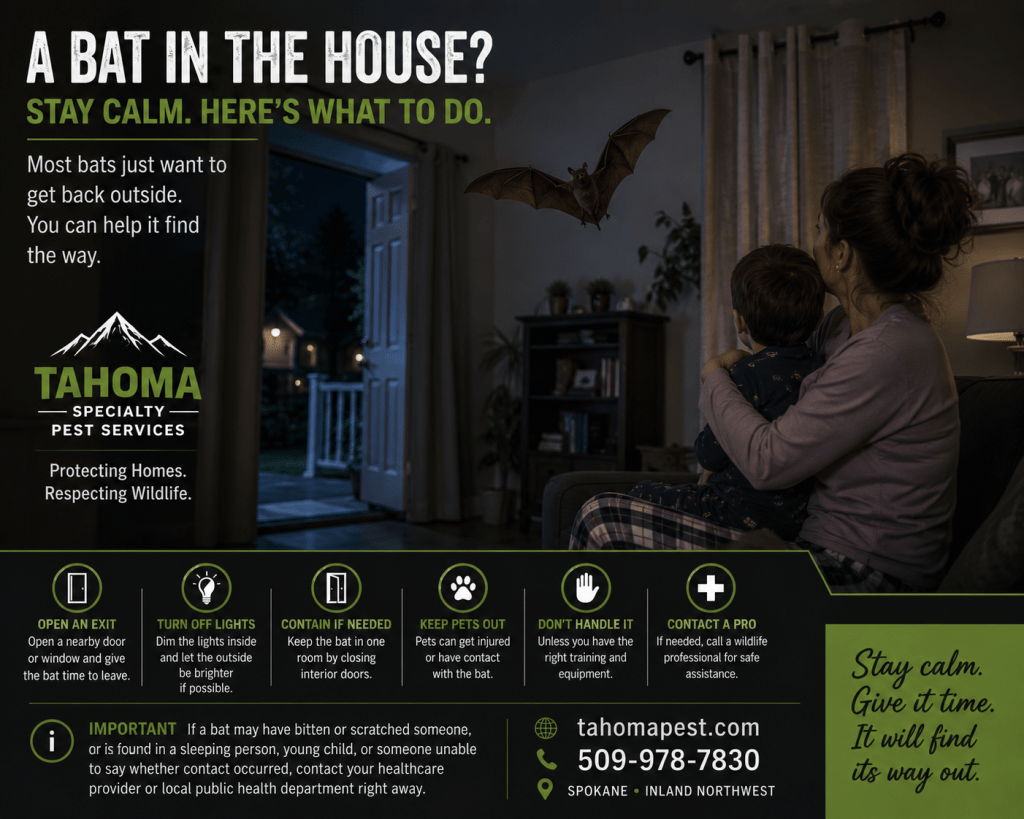
The back door has been open while you’re grilling, or maybe a window was left unscreened. Suddenly, a bat is flying laps around your living room.
First… don’t panic.
As surprising as it is, this happens from time to time.
Avoid:
-Swatting at it.
-Throwing shoes, towels, or other objects.
-Chasing it from room to room.
-Letting pets try to catch it.
Instead, stay calm.
If possible, open an exterior door or window nearby and give the bat some time. Bats are incredible flyers and are extremely sensitive to even the slightest changes in air movement. Once it gets its bearings, it will often locate the open exit and fly back outside on its own.
If the bat doesn’t leave immediately, try to confine it to a single room by closing interior doors. Keeping it contained makes removal much easier if professional assistance is needed.
Unless you have the proper training and equipment, don’t try to catch or handle the bat yourself.
One Important Exception
If you wake up and discover a bat in your bedroom—or if a bat has had direct contact with a person or pet—don’t simply release it if it can be safely contained.
Bat bites can be very small and easy to miss. In these situations, contact your healthcare provider or your local public health department as soon as possible. They can advise whether the bat should be tested for rabies and whether any medical treatment is recommended.
Fortunately, situations like this are uncommon, but they’re important to take seriously.
A bat flying through your home is usually more startling than dangerous. Staying calm, giving it a clear way out, and knowing when to call for help can make all the difference.
Tahoma Specialty Pest Services
🌐 tahomapest.com
📞 509-978-7830
#Spokane #BatExclusion #batremoval #homeownertips

If it seems like wasps have suddenly appeared overnight, you’re not imagining things.
Every summer, I receive a sharp increase in calls around this time of year as nests become large enough for homeowners to finally notice them.
The little golf ball-sized nest you barely noticed a week ago can quickly become the size of a basketball—or even larger—as the colony grows through the summer.
Understanding what’s happening inside the nest helps explain why wasps seem to become more active as the season progresses.
Not All Wasps Build the Same Kind of Nest
The two stinging insects I deal with most often are paper wasps and yellowjackets.
Although they’re related, they behave quite differently.
Paper wasps usually build the familiar open, umbrella-shaped nests beneath roof overhangs, porch ceilings, sheds, decks, and other protected areas. Their nests remain exposed, making them relatively easy to identify.
Yellowjackets, on the other hand, often hide their nests. They may build inside:
-Wall voids
-Roof spaces
-Crawlspaces
-Ground burrows
-Landscape voids
-Other concealed locations
Ground nests are almost always yellowjackets—not paper wasps.
Why They Become So Active Later in the Summer
Throughout spring and early summer, the colony is focused on raising worker wasps.
Those workers spend their days gathering food and expanding the nest.
As August approaches, however, the colony begins shifting its priorities.
Instead of producing more workers, the nest starts producing the next generation of queens that will survive the winter. At the same time, many of the existing workers have fewer colony duties to perform.
That’s one reason yellowjackets often become noticeably more aggressive during late summer—right when families are spending more time outdoors, grilling, gardening, and enjoying their yards.
Can DIY Treatment Work?
Sometimes.
An aerosol wasp spray from your local hardware store can often eliminate a small, exposed paper wasp nest when used carefully and according to the label.
An enclosed yellowjacket nest is a very different situation.
Because the colony is hidden inside a wall, attic, or underground void, spraying the visible entrance usually has little effect on the thousands of wasps protected deeper inside the nest.
By the time you’ve purchased protective clothing, equipment you’ll likely never use again, and several products trying to solve the problem yourself, professional treatment often becomes the more practical option.
What About Wasp Traps?
Wasp traps can absolutely help reduce the number of wasps around a property.
However, it’s important to understand what they’re doing… They attract wasps.
That means they should be placed away from patios, decks, play areas, and other places where people gather.
Many manufacturers recommend placing traps at least 20 to 30 feet away from activity areas, and farther away is often even better if your property allows it.
Traps can reduce pressure on a colony, but they’re rarely enough to eliminate a well-established nest by themselves.
Will Fake Wasp Nests Keep Them Away?
This is one of the most common products I see advertised.
The idea is that wasps supposedly won’t build near another colony.
Unfortunately, real-world experience tells a different story.
I’ve been to plenty of homes with multiple active nests only a few feet apart.
If those fake nests truly worked, my job during wasp season would be a lot easier.
Do Wasps Reuse Their Nests?
No.
Both paper wasps and yellowjackets abandon their nests each fall.
The colony dies, and only newly mated queens survive the winter.
That doesn’t mean you’re in the clear.
If a location proved to be a good nesting site this year, there’s a good chance a new queen will choose the same general area next spring.
Can You Prevent Them?
To some extent.
Early-season preventative treatments around common nesting areas can reduce the likelihood of new colonies becoming established.
Even then, nature doesn’t always cooperate.
No treatment can honestly guarantee that a determined queen won’t decide your home looks like the perfect place to start a new colony.
That’s why inspection remains just as important as treatment.
The Bottom Line
Most wasp problems are easiest to solve when the nests are still small.
By late summer, colonies can contain hundreds—or even thousands—of insects, making treatment much more difficult and increasing the chances of unpleasant encounters.
If you’ve noticed increasing wasp activity around your home, don’t wait until that golf ball-sized nest becomes a basketball hanging over your front door.
Tahoma Specialty Pest Services can identify the species, locate hidden nests, and recommend the safest and most effective solution for your property
Tahoma Specialty Pest Services
Protecting Homes. Respecting Wildlife.
🌐 tahomapest.com
📞 509-978-7830
Spokane • Inland Northwest.
#Spokane #yellowjackets #summerpests #wasps

Most people know bats eat mosquitoes and other insects, making them an important part of our ecosystem. In fact, having bats flying around your property at dusk is usually a good thing.
But there’s a big difference between bats around your home and bats living inside your home.
When bats move into an attic, wall void, or other part of a structure, they can create problems over time.
What Makes Bats a Problem?
Unlike rodents, bats don’t chew wiring or destroy insulation to build nests. Instead, the biggest concerns are:
-Accumulating guano (droppings)
-Strong odors over time
-Staining around entry points
-Noise from an active colony
-Potential health concerns associated with guano accumulation
The longer a colony remains, the more difficult cleanup can become.
Timing Matters
One of the most important things homeowners should know is that bat removal isn’t something that can always be done immediately.
Throughout much of the Inland Northwest, June, July, and August are maternity season.
During this time, young bats are not yet capable of flight. Sealing entry points or attempting exclusion during this period can trap flightless pups inside the structure, creating a much bigger problem for both the animals and the homeowner. Sometimes the best professional solution is to wait until the appropriate time of year, then perform the exclusion correctly.
Please Don’t DIY Bat Removal
This is one wildlife problem where good intentions often make things worse.
Trying to seal holes, install one-way doors, or remove bats without understanding their behavior can accidentally trap bats inside walls, attics, or even force them into your living space.
Bat work isn’t simply about getting them out—it’s about getting every bat out without harming them and making sure they can’t return.
What About Bat Houses?
Bat houses absolutely have value.
However, they’re often misunderstood.
Installing a bat house beside your home usually won’t convince an established colony to voluntarily move out of your attic.
Bat houses work best as an alternative roost after a professional exclusion has been completed, giving displaced bats another suitable place to live while keeping them out of your home.
Proper placement is also critical. Height, sun exposure, orientation, and surrounding habitat all influence whether bats will actually use a bat house.
What If Bats Are Just Hanging Around Outside?
Sometimes the issue isn’t an attic colony at all.
Bats may simply loaf beneath eaves, overhangs, or other sheltered parts of a structure.
In many cases, these situations can be managed using professional exclusion methods, specialized netting systems, or carefully selected deterrent products designed for these specific situations.
Choosing the right approach depends entirely on why the bats are using the structure in the first place.
Every Situation Is Different
The goal isn’t to eliminate bats.
It’s to keep them where they belong.
Bats are valuable wildlife and an important part of our environment. But when they move into your home, solving the problem requires careful planning, proper timing, and the right exclusion methods.
At Tahoma Specialty Pest Services, every bat situation begins with a thorough inspection so we can determine exactly what’s happening, when work can legally and ethically be performed, and the best long-term solution for both the homeowner and the bats.
Tahoma Specialty Pest Services
tahomapest.com / 509 978 7830
One of the most common questions I get is:
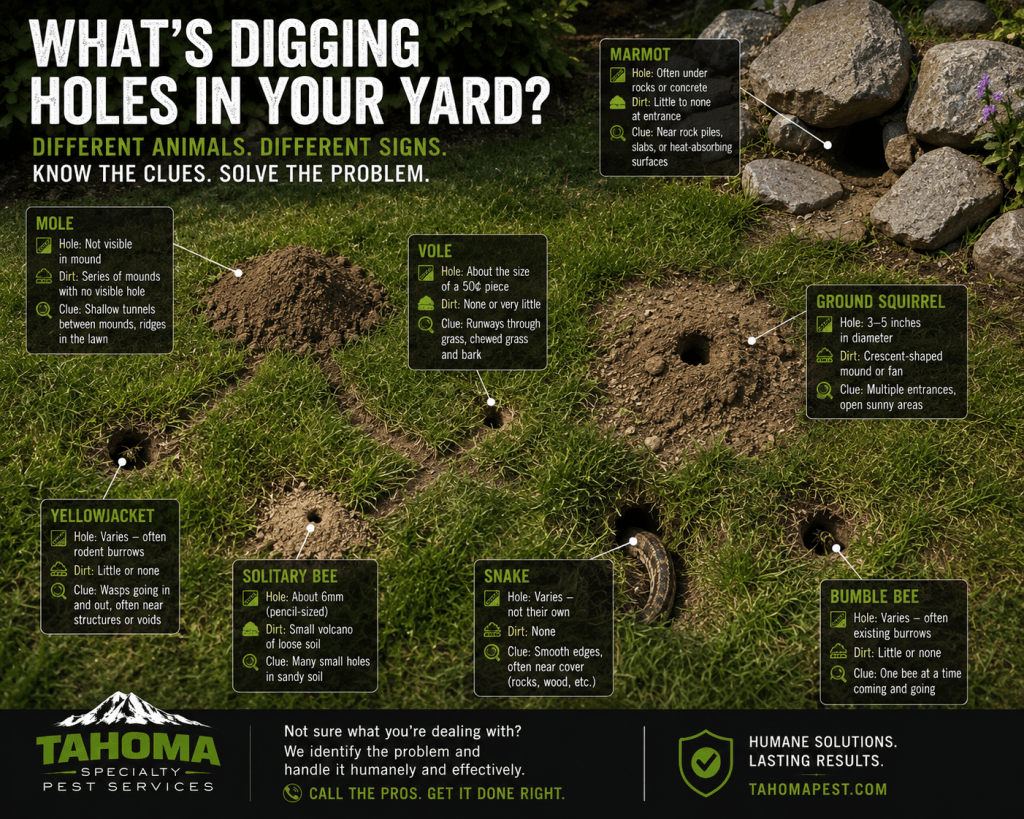
“I found a hole in my yard… what made it?”
The answer isn’t always obvious. Different animals leave different clues, and knowing what you’re looking at is the first step toward solving the problem correctly.
Here are some of the most common culprits we encounter around Spokane and the Inland Northwest.
🦫 Marmots
Marmots rarely dig a hole out in the middle of open ground. Instead, they usually take advantage of existing terrain.
Look for burrows:
Under rocks or boulder piles
Along concrete slabs
Near retaining walls
Under foundations or other heat-absorbing surfaces
If you see a large hole disappearing beneath riprap or a rock pile, there’s a good chance a marmot is involved.
🐿️ Ground Squirrels
Ground squirrels leave one of the easiest burrows to recognize.
Look for:
A hole about 3–5 inches across
A fan- or crescent-shaped mound of excavated dirt
Several active burrows in the same area
Open grassy fields, horse pastures, and agricultural land
For horse owners, these burrows can become a serious safety hazard.
🦡 Moles
People often blame moles for every hole they see, but moles actually leave very distinctive signs.
Look for:
A series of raised soil mounds
No obvious entrance hole in the mound
Shallow surface tunnels connecting the mounds
Moles spend most of their lives underground feeding on earthworms and insects.
🐭 Voles
Voles leave much smaller openings.
Look for:
A hole roughly the size of a 50-cent piece
Little or no loose soil around the entrance
Narrow runways through grass or vegetation
Unlike moles, voles often spend time above ground following these well-worn paths.
🐝 Bumble Bees & Yellowjackets
Not every hole belongs to a mammal.
Both bumble bees and yellowjackets commonly move into abandoned rodent burrows.
A few clues:
Little or no dirt around the entrance
A steady stream of insects flying in and out
Increased activity during warm afternoons
The insects didn’t dig the hole—they simply found a ready-made home.
🐝 Solitary Ground Bees
These beneficial pollinators create tiny pencil-sized holes in loose, sandy soil.
You’ll often notice:
Small volcano-shaped mounds of fine soil
Numerous individual holes spread across an area
Very little aggressive behavior toward people
These bees are important pollinators and are generally best left alone whenever possible.
🐍 Snakes
Snakes almost never dig their own burrows.
Instead, they use:
Abandoned rodent holes
Rock piles
Wood piles
Foundation voids
Other natural hiding places
Finding a snake near a hole doesn’t necessarily mean it made the hole.
Correct Identification Matters
Many burrows look similar at first glance, but treating the wrong animal wastes time, money, and often makes the problem worse.
Before choosing a treatment, it’s important to identify what’s actually living there.
At Tahoma Specialty Pest Services, inspection always comes first. Once we know what’s causing the problem, we can recommend the safest and most effective solution.
If you’ve discovered holes in your lawn, pasture, landscaping, or around your home and you’re not sure what’s responsible, we’re happy to help identify the culprit and develop a plan that actually solves the problem.
Tahoma Specialty Pest Services
Protecting homes, businesses, and property throughout Spokane and the Inland Northwest.
509-978-7830
🌐 tahomapest.com
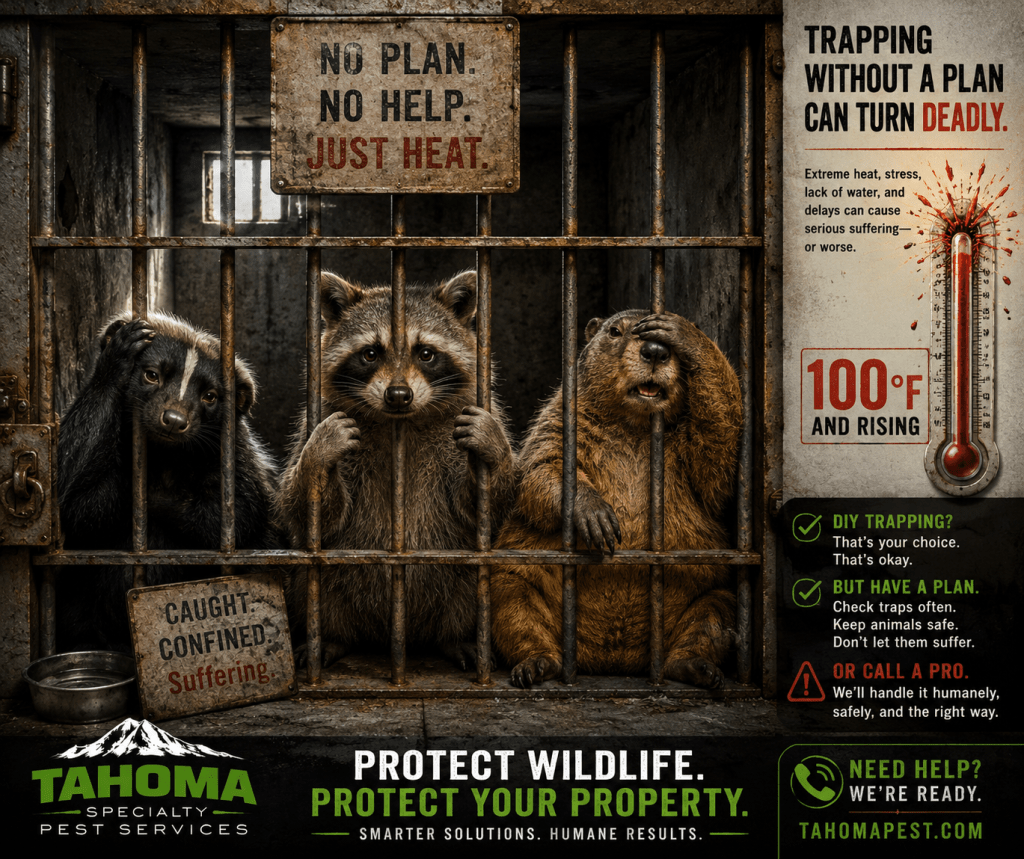
I get it—sometimes folks set a trap hoping to solve a problem. But if you’re DIY-ing it, please have a plan for what’s next. If you catch a skunk—or any wildlife—leaving it in the trap for days isn’t humane (or safe). If you’re unsure what to do with a critter, that’s when you call me. I’ll handle it properly. Better yet, call first—so the critter never gets stuck waiting on a plan.
Call Tahoma Specialty Pest Services
tahomapest.com / 509 978 7830
#WildlifeControl #Spokane #PlanAhead #HumaneRemoval

