
No work today. Tahoma Specialty Pest Services will be closed for Labor Day. We will be back to bust’n bugs tomorrow.
509-978-7830 / tahomapest.com
#Spokane #laborday #endofsummer


Tahoma Specialty Pest Services
Pest and Wildlife Control for Residential and Commercial Clients in the Spokane, and Inland Northwest Region
No work today. Tahoma Specialty Pest Services will be closed for Labor Day. We will be back to bust’n bugs tomorrow.
509-978-7830 / tahomapest.com
#Spokane #laborday #endofsummer

Wildfire changes a landscape in ways that don’t end when the flames are out.
We understandably think first about the people, homes, businesses, and communities affected by fire. But the same landscape was also home to countless wild animals—and when that habitat changes, wildlife has to adapt.
After the amount of ground that has burned around our region this summer, that’s something homeowners in and around affected areas may begin noticing.
And with fall approaching—a time when many animals are already moving around and looking for food and shelter—we may see wildlife activity in some unusual places.
This is an important distinction.
A wildfire doesn’t suddenly create more mice, marmots, squirrels, skunks, raccoons, snakes, or other wildlife.
Instead, fire can remove or alter the things those animals depended upon: cover, food, water, nesting areas and denning locations.
Some animals survive within the burned area. Some leave during the fire and eventually return. Others may move into neighboring areas looking for suitable habitat.
That means properties outside the actual burn area may notice changes too.
If your neighborhood borders thousands of acres of recently burned habitat, wildlife doesn’t recognize your property line. An irrigated lawn, garden, outbuilding, rock wall, deck, crawlspace, woodpile, bird feeder or source of water may suddenly be much more attractive than it was before.
Imagine a rural home that has stood for decades without significant wildlife problems.
There were always better options around it.
Plenty of natural cover. Plenty of places to den. Plenty of food and water.
Now imagine much of that surrounding habitat has burned while the house and immediate property remain intact.
Nothing about the house changed.
Everything around it did.
That doesn’t mean wildlife is inevitably going to move into the structure. But it does mean a vulnerability that never mattered before might matter now.
A damaged crawlspace vent.
A gap beneath a deck.
An opening beneath a shed.
A loose section of siding.
A hole beneath a concrete slab.
An accessible attic or roof opening.
Those conditions may have existed for years without causing a problem simply because nothing had much reason to use them.
Changing the surrounding habitat can change that equation.
This is equally important.
Not every animal that appears on your property needs to be trapped.
If you’ve never seen a particular animal in your yard before and suddenly one walks through, that doesn’t necessarily make it a nuisance animal.
It may simply be passing through.
Give wildlife space. Keep pets away from unfamiliar animals. Don’t leave food out for them, and don’t attempt to capture an animal simply because it showed up somewhere unexpected.
There’s an important difference between wildlife on your property and wildlife causing a problem on your property.
An animal passing through the backyard is one thing.
An animal establishing a den beneath your foundation, entering the crawlspace, damaging the structure, or repeatedly returning because it has found a dependable food source is another.
That’s when intervention may become appropriate.
For properties near affected areas, one of the best things you can do right now is simply take a look around.
Check crawlspace vents and access doors.
Look beneath decks, sheds and outbuildings.
Watch for new excavation around foundations and concrete.
Look for openings around the roofline.
Secure garbage, pet food, chicken feed and birdseed.
Pick up fallen fruit and eliminate unnecessary food sources.
Pay attention to new tracks, droppings, digging or other signs of activity.
You don’t need to turn your home into a fortress.
You just need to recognize that conditions around it may have changed.
Wildlife control doesn’t always need to begin with traps.
Tahoma Specialty Pest Services also provides wildlife inspections and consultations.
If you’re near a burned area and aren’t sure whether your property has vulnerabilities, I can inspect the structure and surrounding property, identify potential entry points or attractants, and help determine whether anything actually needs to be done.
Sometimes I’ll find something that should be corrected.
Sometimes the recommendation may simply be to keep an eye on an area.
And sometimes I’ll tell you there’s nothing worth worrying about.
The point of an inspection isn’t to find something I can sell you.
It’s to find out whether there’s actually a problem—or a realistic opportunity for one to develop.
Wildfire can change insect activity too, although not always in the ways people might expect.
Some insects are displaced or decline after a fire, while others actually specialize in recently burned or fire-damaged habitat. Certain wood-boring beetles, for example, can locate stressed and freshly burned trees using smoke-related chemical cues—and some fire-associated beetles can even detect infrared radiation from fires.
It’s fascinating biology, but it doesn’t mean a wave of insects is necessarily headed for nearby homes.
The more useful takeaway is simply that fire changes the entire ecosystem, and insect activity and pressure can change along with everything else.
The amount of land burned around our region this year has been significant, and we’re probably going to be seeing some of the ecological effects for quite a while.
Some wildlife will return to burned areas.
Some will establish themselves somewhere else.
Some may show up in places where homeowners have rarely—or never—seen them before.
Most of those encounters won’t require pest control.
But when wildlife begins using a home or structure for shelter, knowing about vulnerabilities before an animal establishes itself can make the situation considerably easier to manage.
So if you live near one of this year’s burned areas, don’t panic about every critter that wanders through your yard.
Just pay attention.
Their neighborhood changed too.
Tahoma Specialty Pest Services
Spokane & the Inland Northwest
509-978-7830
tahomapest.com
#Spokane #SpokaneWA #spokanefire #Wildfire #Wildlife #WildlifeControl #WildlifeAwareness #HomeownerTips #Spokanecomplexfire #oldtrailsfire #fairviewfire #autumnlanefire

I recognize that the people I want to see this probably won’t… At least not from their own scrolling. They are far too busy right now, and probably not thinking about pest control. If you are a spouse, other family, or a friend of a firefighter, go ahead and contact us for them, we will take care of the rest.
tahomapest.com / 509-978-7830

This offer is for our region’s firefighters. As a thank you for protecting our homes, I want to do what I can to protect your’s. Our region is in debt to you, you will not pay a dime for my service.
tahomapest.com / 509-978-7830

It’s a beautiful summer evening.
The back door has been open while you’re grilling, or maybe a window was left unscreened. Suddenly, a bat is flying laps around your living room.
First… don’t panic.
As surprising as it is, this happens from time to time.
Avoid:
-Swatting at it.
-Throwing shoes, towels, or other objects.
-Chasing it from room to room.
-Letting pets try to catch it.
Instead, stay calm.
If possible, open an exterior door or window nearby and give the bat some time. Bats are incredible flyers and are extremely sensitive to even the slightest changes in air movement. Once it gets its bearings, it will often locate the open exit and fly back outside on its own.
If the bat doesn’t leave immediately, try to confine it to a single room by closing interior doors. Keeping it contained makes removal much easier if professional assistance is needed.
Unless you have the proper training and equipment, don’t try to catch or handle the bat yourself.
One Important Exception
If you wake up and discover a bat in your bedroom—or if a bat has had direct contact with a person or pet—don’t simply release it if it can be safely contained.
Bat bites can be very small and easy to miss. In these situations, contact your healthcare provider or your local public health department as soon as possible. They can advise whether the bat should be tested for rabies and whether any medical treatment is recommended.
Fortunately, situations like this are uncommon, but they’re important to take seriously.
A bat flying through your home is usually more startling than dangerous. Staying calm, giving it a clear way out, and knowing when to call for help can make all the difference.
Tahoma Specialty Pest Services
🌐 tahomapest.com
📞 509-978-7830
#Spokane #BatExclusion #batremoval #homeownertips

Most people know bats eat mosquitoes and other insects, making them an important part of our ecosystem. In fact, having bats flying around your property at dusk is usually a good thing.
But there’s a big difference between bats around your home and bats living inside your home.
When bats move into an attic, wall void, or other part of a structure, they can create problems over time.
What Makes Bats a Problem?
Unlike rodents, bats don’t chew wiring or destroy insulation to build nests. Instead, the biggest concerns are:
-Accumulating guano (droppings)
-Strong odors over time
-Staining around entry points
-Noise from an active colony
-Potential health concerns associated with guano accumulation
The longer a colony remains, the more difficult cleanup can become.
Timing Matters
One of the most important things homeowners should know is that bat removal isn’t something that can always be done immediately.
Throughout much of the Inland Northwest, June, July, and August are maternity season.
During this time, young bats are not yet capable of flight. Sealing entry points or attempting exclusion during this period can trap flightless pups inside the structure, creating a much bigger problem for both the animals and the homeowner. Sometimes the best professional solution is to wait until the appropriate time of year, then perform the exclusion correctly.
Please Don’t DIY Bat Removal
This is one wildlife problem where good intentions often make things worse.
Trying to seal holes, install one-way doors, or remove bats without understanding their behavior can accidentally trap bats inside walls, attics, or even force them into your living space.
Bat work isn’t simply about getting them out—it’s about getting every bat out without harming them and making sure they can’t return.
What About Bat Houses?
Bat houses absolutely have value.
However, they’re often misunderstood.
Installing a bat house beside your home usually won’t convince an established colony to voluntarily move out of your attic.
Bat houses work best as an alternative roost after a professional exclusion has been completed, giving displaced bats another suitable place to live while keeping them out of your home.
Proper placement is also critical. Height, sun exposure, orientation, and surrounding habitat all influence whether bats will actually use a bat house.
What If Bats Are Just Hanging Around Outside?
Sometimes the issue isn’t an attic colony at all.
Bats may simply loaf beneath eaves, overhangs, or other sheltered parts of a structure.
In many cases, these situations can be managed using professional exclusion methods, specialized netting systems, or carefully selected deterrent products designed for these specific situations.
Choosing the right approach depends entirely on why the bats are using the structure in the first place.
Every Situation Is Different
The goal isn’t to eliminate bats.
It’s to keep them where they belong.
Bats are valuable wildlife and an important part of our environment. But when they move into your home, solving the problem requires careful planning, proper timing, and the right exclusion methods.
At Tahoma Specialty Pest Services, every bat situation begins with a thorough inspection so we can determine exactly what’s happening, when work can legally and ethically be performed, and the best long-term solution for both the homeowner and the bats.
Tahoma Specialty Pest Services
tahomapest.com / 509 978 7830

One of the most common questions I get is:
“I found a hole in my yard… what made it?”
The answer isn’t always obvious. Different animals leave different clues, and knowing what you’re looking at is the first step toward solving the problem correctly.
Here are some of the most common culprits we encounter around Spokane and the Inland Northwest.
🦫 Marmots
Marmots rarely dig a hole out in the middle of open ground. Instead, they usually take advantage of existing terrain.
Look for burrows:
Under rocks or boulder piles
Along concrete slabs
Near retaining walls
Under foundations or other heat-absorbing surfaces
If you see a large hole disappearing beneath riprap or a rock pile, there’s a good chance a marmot is involved.
🐿️ Ground Squirrels
Ground squirrels leave one of the easiest burrows to recognize.
Look for:
A hole about 3–5 inches across
A fan- or crescent-shaped mound of excavated dirt
Several active burrows in the same area
Open grassy fields, horse pastures, and agricultural land
For horse owners, these burrows can become a serious safety hazard.
🦡 Moles
People often blame moles for every hole they see, but moles actually leave very distinctive signs.
Look for:
A series of raised soil mounds
No obvious entrance hole in the mound
Shallow surface tunnels connecting the mounds
Moles spend most of their lives underground feeding on earthworms and insects.
🐭 Voles
Voles leave much smaller openings.
Look for:
A hole roughly the size of a 50-cent piece
Little or no loose soil around the entrance
Narrow runways through grass or vegetation
Unlike moles, voles often spend time above ground following these well-worn paths.
🐝 Bumble Bees & Yellowjackets
Not every hole belongs to a mammal.
Both bumble bees and yellowjackets commonly move into abandoned rodent burrows.
A few clues:
Little or no dirt around the entrance
A steady stream of insects flying in and out
Increased activity during warm afternoons
The insects didn’t dig the hole—they simply found a ready-made home.
🐝 Solitary Ground Bees
These beneficial pollinators create tiny pencil-sized holes in loose, sandy soil.
You’ll often notice:
Small volcano-shaped mounds of fine soil
Numerous individual holes spread across an area
Very little aggressive behavior toward people
These bees are important pollinators and are generally best left alone whenever possible.
🐍 Snakes
Snakes almost never dig their own burrows.
Instead, they use:
Abandoned rodent holes
Rock piles
Wood piles
Foundation voids
Other natural hiding places
Finding a snake near a hole doesn’t necessarily mean it made the hole.
Correct Identification Matters
Many burrows look similar at first glance, but treating the wrong animal wastes time, money, and often makes the problem worse.
Before choosing a treatment, it’s important to identify what’s actually living there.
At Tahoma Specialty Pest Services, inspection always comes first. Once we know what’s causing the problem, we can recommend the safest and most effective solution.
If you’ve discovered holes in your lawn, pasture, landscaping, or around your home and you’re not sure what’s responsible, we’re happy to help identify the culprit and develop a plan that actually solves the problem.
Tahoma Specialty Pest Services
Protecting homes, businesses, and property throughout Spokane and the Inland Northwest.
509-978-7830
🌐 tahomapest.com
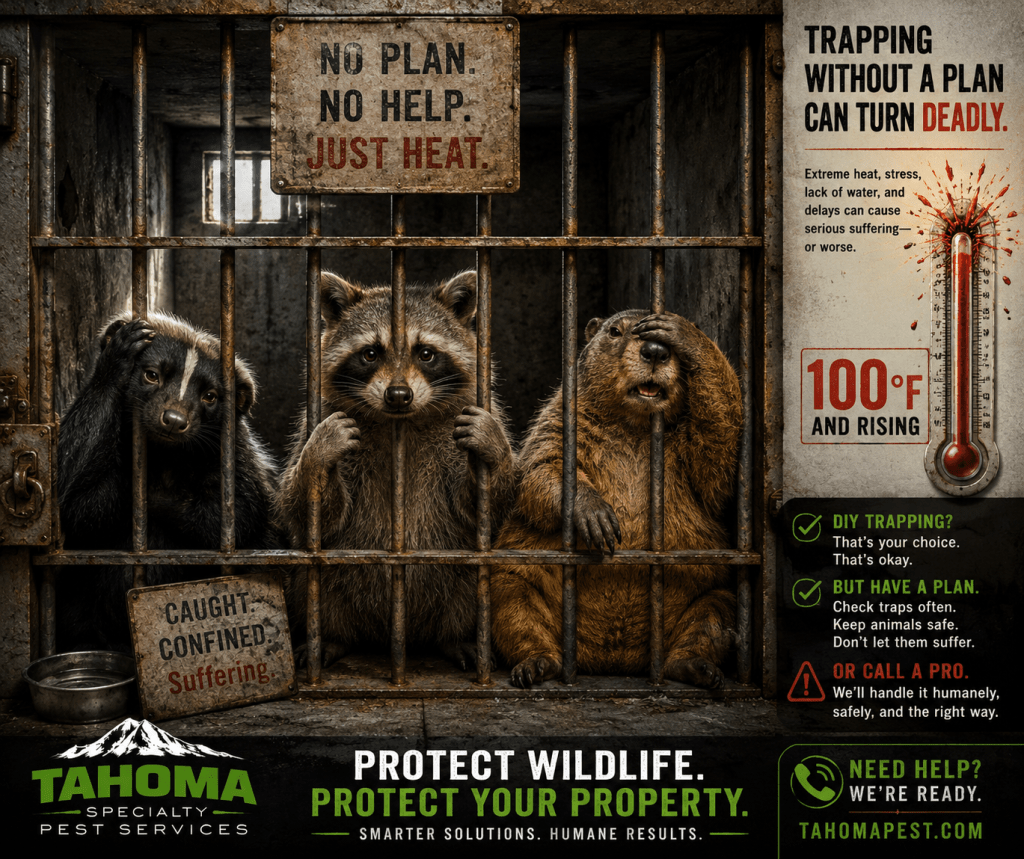
I get it—sometimes folks set a trap hoping to solve a problem. But if you’re DIY-ing it, please have a plan for what’s next. If you catch a skunk—or any wildlife—leaving it in the trap for days isn’t humane (or safe). If you’re unsure what to do with a critter, that’s when you call me. I’ll handle it properly. Better yet, call first—so the critter never gets stuck waiting on a plan.
Call Tahoma Specialty Pest Services
tahomapest.com / 509 978 7830
#WildlifeControl #Spokane #PlanAhead #HumaneRemoval