
Informative, fun, and educational posts will be back again next week.
We will not be open during the Memorial Day Weekend.
Tahoma Specialty Pest Services
Pest and Wildlife Control for Residential and Commercial Clients in the Spokane, and Inland Northwest Region

Informative, fun, and educational posts will be back again next week.
We will not be open during the Memorial Day Weekend.

If you’ve noticed millipedes on your driveway, walkways, around the front door, in the garage, or even on the exterior of your home, you’re not alone — especially in newer developments.
I tend to see this most often around newer construction neighborhoods where natural ground cover has recently been disturbed and replaced with fresh landscaping, concrete, and irrigated lawns.
Millipedes normally live in moist soil, leaf litter, and decaying organic material. When those environments are disrupted by construction and development, they often end up migrating into surrounding areas looking for moisture and shelter.
That’s why they commonly gather:
on concrete driveways and sidewalks
around garage doors
near foundation edges
and along the exterior of homes
Concrete and landscaping around newer homes can hold moisture surprisingly well, especially after watering or rain, creating ideal conditions for them to wander through the area.
The good news is that millipedes are mostly a nuisance pest. They don’t bite, sting, or damage structures.
That said, large numbers can definitely become annoying.
The perimeter treatments I apply for ants, spiders, and other crawling insects will also help reduce millipede activity around the home. Treatment focuses on the exterior foundation, entry points, garage areas, and the conditions allowing them to gather in the first place.
Like many pest issues, it’s often less about the pest itself and more about the environment attracting them.
Tahoma Specialty Pest Services
509-978-7830
tahomapest.com

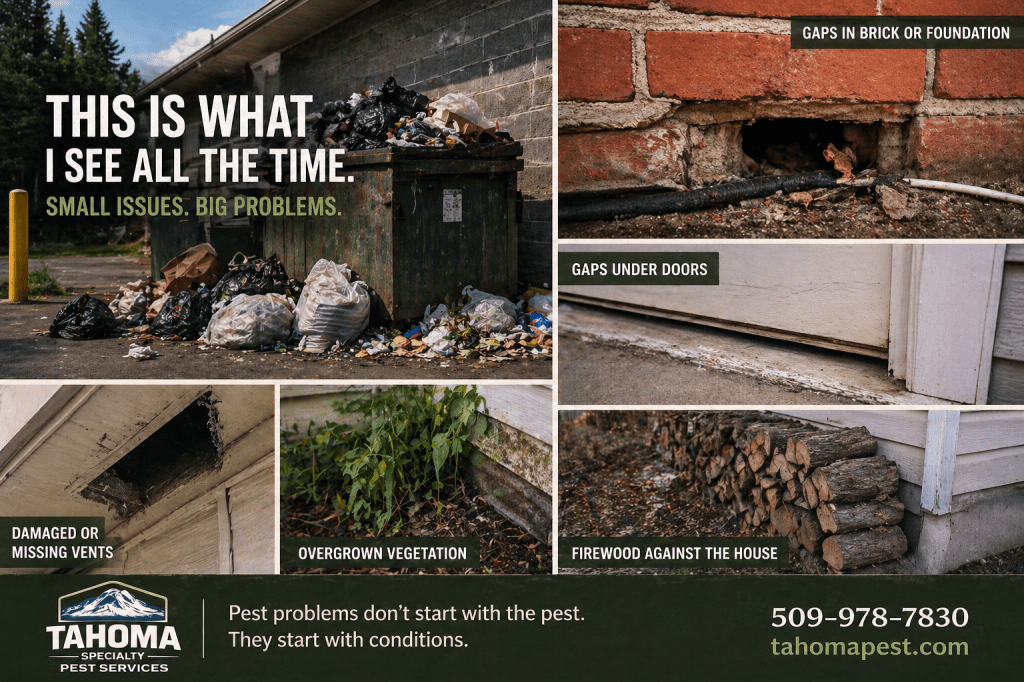
This is what I see all the time.
Small gaps, overlooked openings, and conditions that don’t seem like a big deal at first glance.
A gap under a door.
A break in the foundation.
An opening around the structure.
These are the kinds of things that allow pests and wildlife to get in.
Most of the time, the issue isn’t complicated — it’s just something that went unnoticed.
Once that opening exists, it becomes an easy access point.
From there, the problem develops.
That’s why I spend a lot of time looking at the structure itself.
Not just what’s inside — but how it got there in the first place.
Because if the access point isn’t addressed, the problem usually comes back.
Tahoma Specialty Pest Services
509-978-7830
tahomapest.com

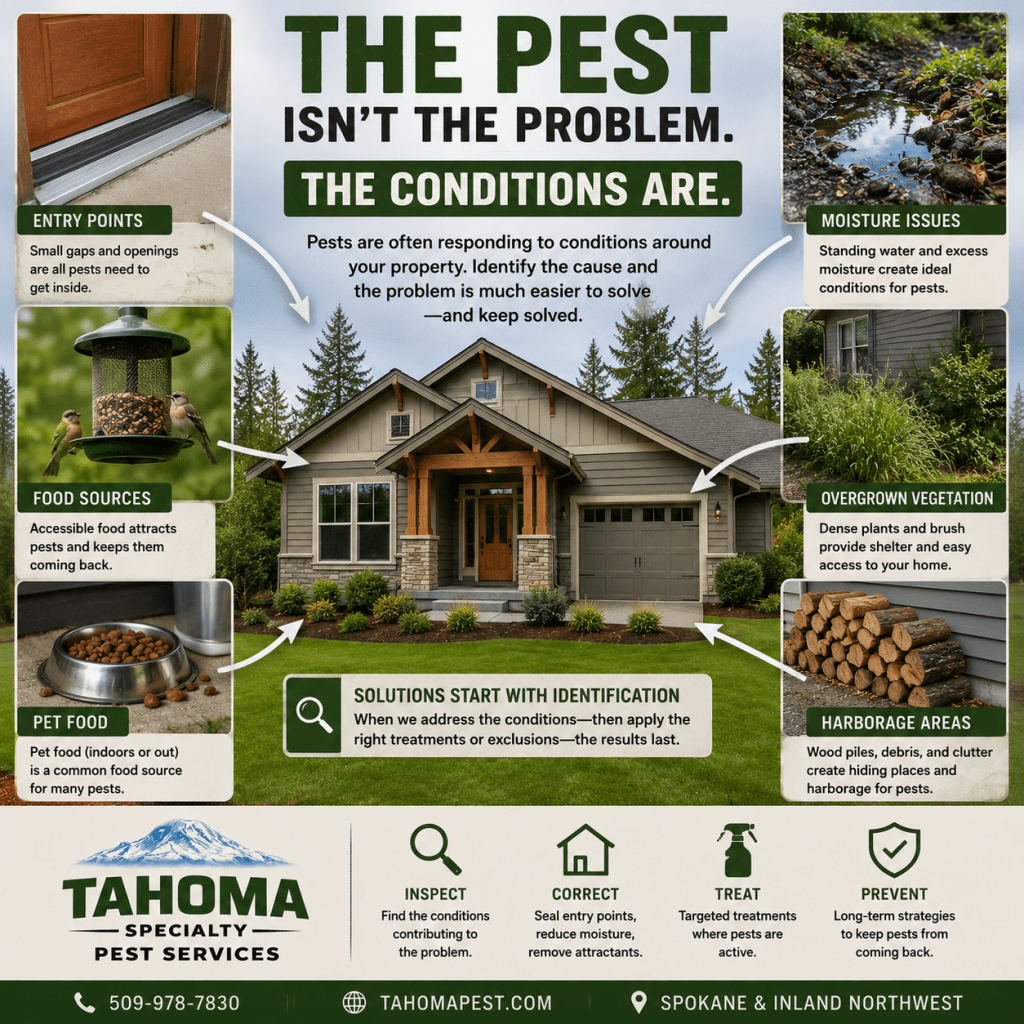
Pest problems don’t usually start with the pest.
They start with conditions.
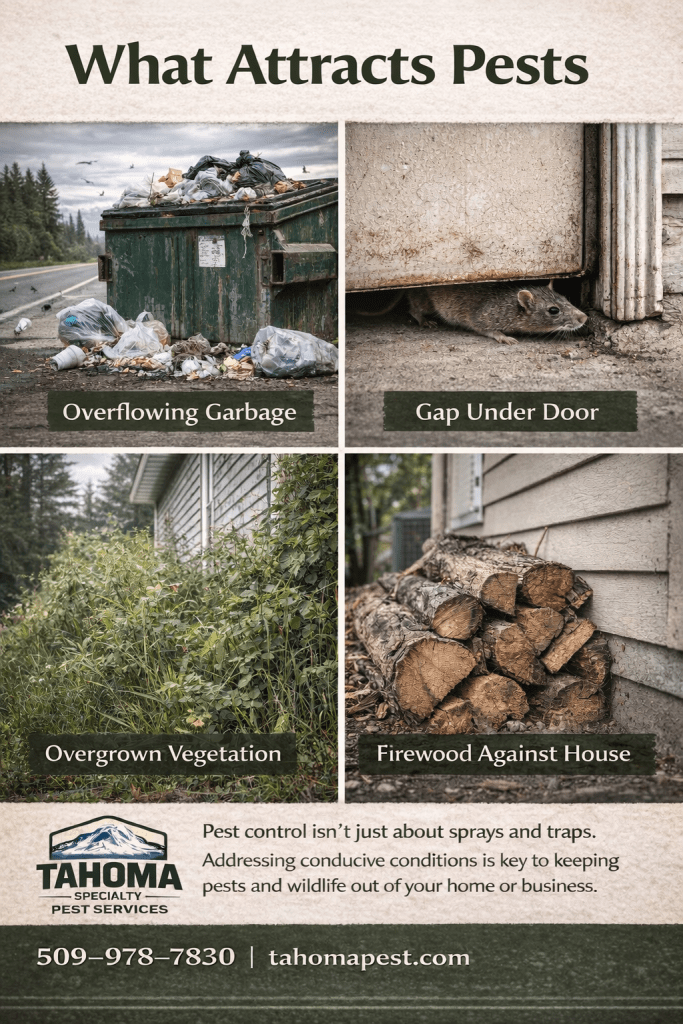
Things like overflowing garbage, gaps around doors, overgrown vegetation, and materials stored against the structure all create opportunities for pests and wildlife to move in.
For example:
Overflowing garbage can attract a wide range of pests, from insects to rodents and even larger wildlife.
Gaps under doors or around the structure provide easy entry points, especially for rodents.
Overgrown vegetation creates cover and shelter, allowing pests to move undetected right up to the home.
Firewood or debris stacked against the house can hold moisture and provide harborage for insects and other pests.
In many cases, these conditions go unnoticed until a problem develops.
That’s why pest control isn’t just about sprays and traps.
Those tools have their place, but if the underlying conditions aren’t addressed, the problem often returns.
When I look at a property, I’m not just looking for pests — I’m looking at what’s allowing them to be there in the first place.
That may involve:
identifying entry points
pointing out attractants
recommending changes to the property
Sometimes the solution involves treatment.
Sometimes it involves correcting conditions.
Sometimes it involves both.
In some cases, I can take care of those corrections directly. In others, I’ll point you in the right direction and help guide the process.
The goal is to solve the issue — not just treat the symptoms.
Tahoma Specialty Pest Services
509-978-7830
tahomapest.com

As temperatures begin to warm up, it’s common to start noticing more spider activity around homes.
While spiders are often seen as the problem, they’re usually a sign of something else going on.
Spiders follow food.
As insect activity increases in the spring, spiders begin to show up in areas where food is available. This often includes:
• around exterior lighting
• along siding and eaves
• near entry points
• inside garages and basements
In many cases, the presence of spiders indicates that other insects are active in and around the structure.
Because of this, focusing only on spiders doesn’t usually address the root of the issue.
Effective control comes from reducing the underlying insect activity and maintaining a consistent exterior treatment around the home.
As overall pest pressure increases through the season, spider activity often follows the same pattern.
Tahoma Specialty Pest Services
509-978-7830
tahomapest.com