
Ticks: What You Should Know Before Heading Outdoors

As the weather warms up, people spend more time hiking, camping, working outdoors, and enjoying their property.
It’s also the time of year when ticks become more active.

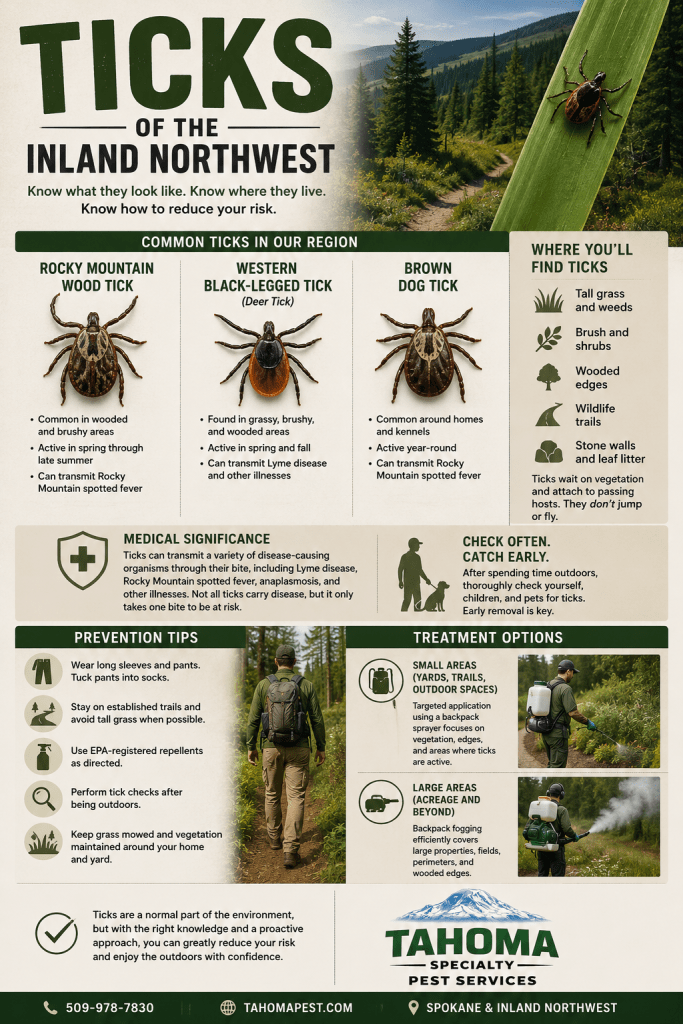
Ticks are commonly found in:
-tall grass
-brushy areas
-wooded edges
-overgrown vegetation
-wildlife travel corridors

Contrary to popular belief, ticks don’t jump or fly. They wait on vegetation and grab onto passing animals or people as they move through an area.
Several tick species can be found throughout Washington and the Inland Northwest. While most tick bites are little more than an unpleasant nuisance, ticks are medically significant because they can transmit disease-causing organisms through their bite.
Fortunately, the risk can be greatly reduced through awareness and prevention.

A few simple steps include:
-staying on established trails
-avoiding tall grass when possible
-wearing long pants and light-colored clothing
-performing tick checks after spending time outdoors
-keeping vegetation around homes and recreational areas maintained

For properties with persistent tick activity, treatment can also be very effective.
For smaller areas, I typically apply a targeted treatment using a backpack sprayer. Larger properties, such as acreages, may be treated using a backpack fogger to efficiently cover broader areas where ticks are active.
Treatment focuses on vegetation, edge habitat, travel corridors, and the places ticks are most likely to be encountered.
Like many pest issues, the goal isn’t simply to react to a problem after it occurs. It’s to reduce the likelihood of encountering one in the first place.


Tahoma Specialty Pest Services
509-978-7830
tahomapest.com

Why You’re Seeing Millipedes Around Your Home

If you’ve noticed millipedes on your driveway, walkways, around the front door, in the garage, or even on the exterior of your home, you’re not alone — especially in newer developments.
I tend to see this most often around newer construction neighborhoods where natural ground cover has recently been disturbed and replaced with fresh landscaping, concrete, and irrigated lawns.
Millipedes normally live in moist soil, leaf litter, and decaying organic material. When those environments are disrupted by construction and development, they often end up migrating into surrounding areas looking for moisture and shelter.
That’s why they commonly gather:
on concrete driveways and sidewalks
around garage doors
near foundation edges
and along the exterior of homes
Concrete and landscaping around newer homes can hold moisture surprisingly well, especially after watering or rain, creating ideal conditions for them to wander through the area.
The good news is that millipedes are mostly a nuisance pest. They don’t bite, sting, or damage structures.
That said, large numbers can definitely become annoying.
The perimeter treatments I apply for ants, spiders, and other crawling insects will also help reduce millipede activity around the home. Treatment focuses on the exterior foundation, entry points, garage areas, and the conditions allowing them to gather in the first place.
Like many pest issues, it’s often less about the pest itself and more about the environment attracting them.
Tahoma Specialty Pest Services
509-978-7830
tahomapest.com

A Quick Note About Hantavirus And Rodent Cleanup

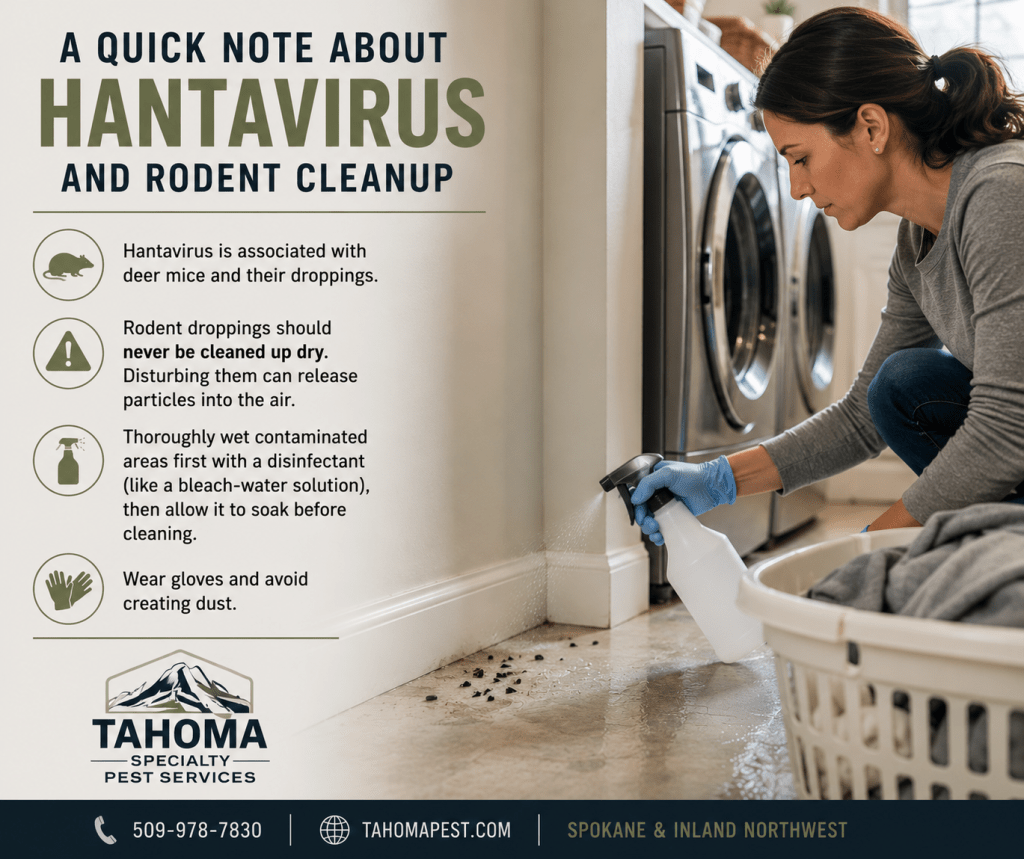
Recent news coverage has brought renewed attention to hantavirus, which is associated with deer mice and exposure to contaminated droppings.
Here in the Inland Northwest, deer mice are commonly found in rural and wooded environments, though finding them around Spokane and even within city areas is not unheard of.
One important thing people should know is that rodent droppings should never be cleaned up dry.
Sweeping or vacuuming dry droppings can disturb particles into the air where they may be inhaled.
Instead:
thoroughly wet droppings and contaminated areas first
use a bleach-water solution or appropriate disinfectant
allow it to soak before cleanup
avoid creating dust during the process
Most rodent issues are nuisance problems, but proper cleanup and exclusion still matter.
Tahoma Specialty Pest Services
509-978-7830
tahomapest.com

Seeing More Seed Bugs This Year? Here’s What’s Going On

Seed bugs are a common issue around homes in this area, and this year they seem to be showing up in higher numbers than usual.

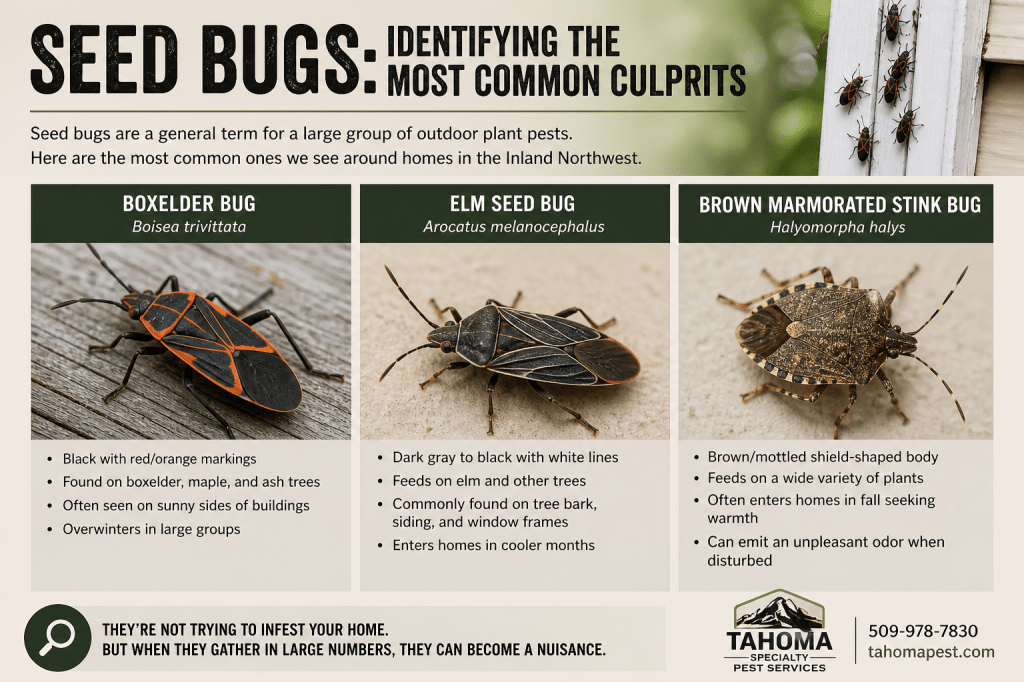
“Seed bugs” isn’t just one insect — it’s a general term people use for a group of outdoor plant-feeding insects. Around here, that often includes:

-boxelder bugs
-elm seed bugs
-stink bugs

These insects primarily live outdoors, feeding on plants and trees, but they tend to gather on homes in large numbers as temperatures shift.
You’ll usually see them:

-on sunny sides of the house
-around siding and foundations
-near doors, windows, and entry points

They’re not trying to infest the home, but once they gather in large numbers, some will find their way inside through small gaps and openings. That’s where they become a nuisance.
This year, activity seems heavier than normal, likely due to a milder winter. When conditions allow more of them to survive, populations build up quickly.
The key to controlling seed bugs isn’t chasing the ones you see inside — it’s managing what’s happening on the outside.
An exterior treatment, similar to what’s used for ants and spiders, is typically very effective. The focus is on:

-nooks and crannies
-warm surfaces where they gather
-entry points around the structure

Timing also matters.
Spring and fall are the most important times to stay ahead of activity and prevent large numbers from building up.
In more severe cases, especially during winter when bugs have already moved into wall voids or attic spaces, additional treatments such as attic fogging may be needed.

Like most pest issues, the goal isn’t just to react — it’s to get ahead of the conditions that allow the problem to develop in the first place.

Tahoma Specialty Pest Services
509-978-7830
tahomapest.com

What Attracts Pest?

Pest problems don’t usually start with the pest.
They start with conditions.
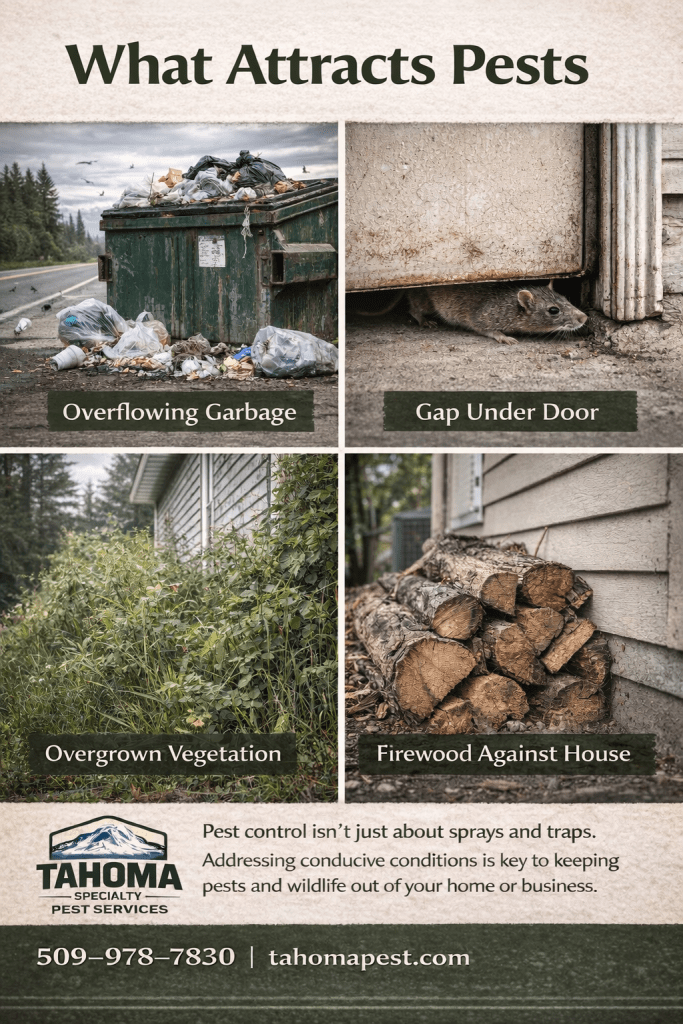
Things like overflowing garbage, gaps around doors, overgrown vegetation, and materials stored against the structure all create opportunities for pests and wildlife to move in.
For example:
Overflowing garbage can attract a wide range of pests, from insects to rodents and even larger wildlife.
Gaps under doors or around the structure provide easy entry points, especially for rodents.
Overgrown vegetation creates cover and shelter, allowing pests to move undetected right up to the home.
Firewood or debris stacked against the house can hold moisture and provide harborage for insects and other pests.
In many cases, these conditions go unnoticed until a problem develops.
That’s why pest control isn’t just about sprays and traps.
Those tools have their place, but if the underlying conditions aren’t addressed, the problem often returns.
When I look at a property, I’m not just looking for pests — I’m looking at what’s allowing them to be there in the first place.
That may involve:
identifying entry points
pointing out attractants
recommending changes to the property
Sometimes the solution involves treatment.
Sometimes it involves correcting conditions.
Sometimes it involves both.
In some cases, I can take care of those corrections directly. In others, I’ll point you in the right direction and help guide the process.
The goal is to solve the issue — not just treat the symptoms.
Tahoma Specialty Pest Services
509-978-7830
tahomapest.com

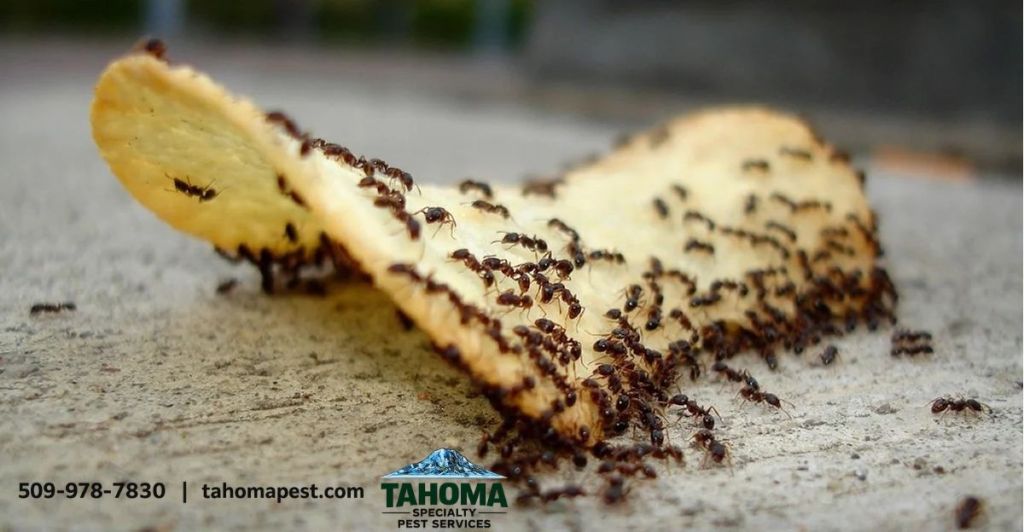
Why Ant Problems Keep Coming Back (And What Actually Works)

Ant problems are one of the most common issues homeowners deal with, especially as temperatures begin to warm up.
What most people don’t realize is that the way ants are treated often determines whether the problem actually goes away — or keeps coming back.
One of the biggest mistakes is using over-the-counter sprays inside the home.
With species like odorous house ants, spraying can actually make the problem worse. Instead of eliminating the colony, it can cause it to split and spread, leading to more activity in multiple areas.
Effective treatment focuses on the colony itself.
Interior treatments typically involve placing baits where ants are actively foraging. These baits are carried back to the colony, allowing it to be eliminated at the source.
On the exterior, treatments are applied around the structure to create a barrier and reduce incoming activity. Depending on conditions, this may involve liquid applications or granular materials during wetter periods.
Because materials don’t last indefinitely, and because ant pressure can change throughout the season, ongoing treatment is often the most effective way to maintain control.
At Tahoma Specialty Pest Services, we typically recommend service three times per year to stay ahead of activity.
We also take a different approach than many companies — there are no contracts. We call it satisfaction-based service. If you’re happy with the service and want it to continue, we keep going. If not, we don’t.
Ant treatments can also help reduce other crawling insects, including spiders, as part of the same process.
Tahoma Specialty Pest Services
509-978-7830
tahomapest.com

Where Animals Start Getting Into Homes Around Spokane in Early Spring

As temperatures begin to warm around Spokane, pest and wildlife activity begins to increase.
One of the most common issues this time of year isn’t just the animals themselves — it’s how they get into structures in the first place.
Many homes have small openings that go unnoticed until activity starts picking up in spring.
Common entry points include:
• gaps along rooflines and eaves
• attic vents and soffit openings
• areas where utilities enter the home
• damaged or loose vent screens
• gaps along foundations or under siding
Wildlife like squirrels, raccoons, and rodents are especially good at finding these weak points. Once inside, they can nest in attics, crawlspaces, or wall voids.
In many cases, the problem isn’t just removing the animal — it’s identifying and addressing the entry point that allowed it in.
Spring is often when these issues first become noticeable, as animals become more active and begin looking for shelter or nesting locations.
If you’re hearing movement, noticing damage, or seeing signs of activity, there’s usually a structural reason behind it.
Tahoma Specialty Pest Services
509-978-7830
tahomapest.com

Why Wasps Start Showing Up Around Spokane Homes in Early Spring

As temperatures begin warming around Spokane, homeowners often start noticing a few wasps showing up around their property.

This can be surprising because it’s still early in the season. But these aren’t random insects wandering around — they’re queen wasps that have just emerged from winter hibernation.

Each spring, a single fertilized queen wakes up and begins searching for a place to start a new nest.

Common places queens scout include:

• roof eaves and overhangs
• sheds and outbuildings
• porch ceilings
• attic vents
• wall voids

At this stage, there is only one wasp, but she is looking for a protected location where she can begin building the first cells of a nest.

Once eggs are laid and the first workers emerge, the nest can grow quickly through late spring and summer.

Early-season sightings don’t necessarily mean a large nest is present yet — but they do mean queens are actively scouting around structures.

Tahoma Specialty Pest Services
509-978-7830
tahomapest.com

Marmots Are Waking Up Around Spokane

With spring approaching in the Inland Northwest, one of the first nuisance wildlife problems to reappear around Spokane is marmots.
Also known as rock chucks or whistle pigs, these large burrowing rodents spend most of the winter in deep hibernation. As temperatures begin to warm, they start emerging hungry and ready to reclaim territory.
For homeowners, that’s often when the trouble begins.

Where They Show Up Around Homes
In the Spokane area.

Marmots commonly burrow around:
-Retaining walls                                              -Concrete slabs
-Rock landscaping
-Foundations
-Decks and sheds
These burrow systems can extend 15–30 feet underground, and over time they can undermine structures and cause settling or collapse.
Areas along the Spokane River corridor and the I-90 area tend to see particularly heavy marmot activity.

Signs You Might Have Marmots Nearby

Homeowners usually notice:
Large burrow openings (6–10 inches wide)
Fresh dirt piles near rocks or structures
Chewed vegetation or garden damage
Marmots sunning themselves on rocks or retaining walls A sharp whistling alarm call (where the nickname whistle pig comes from)

Why Early Spring Matters

When marmots wake up from hibernation they immediately start:
Feeding heavily
Reestablishing territory
Preparing for breeding season
Addressing activity early in the season can prevent larger problems later in the year.
If you’re seeing marmot activity around your property in the Spokane area, early intervention is often the best approach.

Tahoma Specialty Pest Services
509-978-7830
tahomapest.com

#Spokane

#marmots