

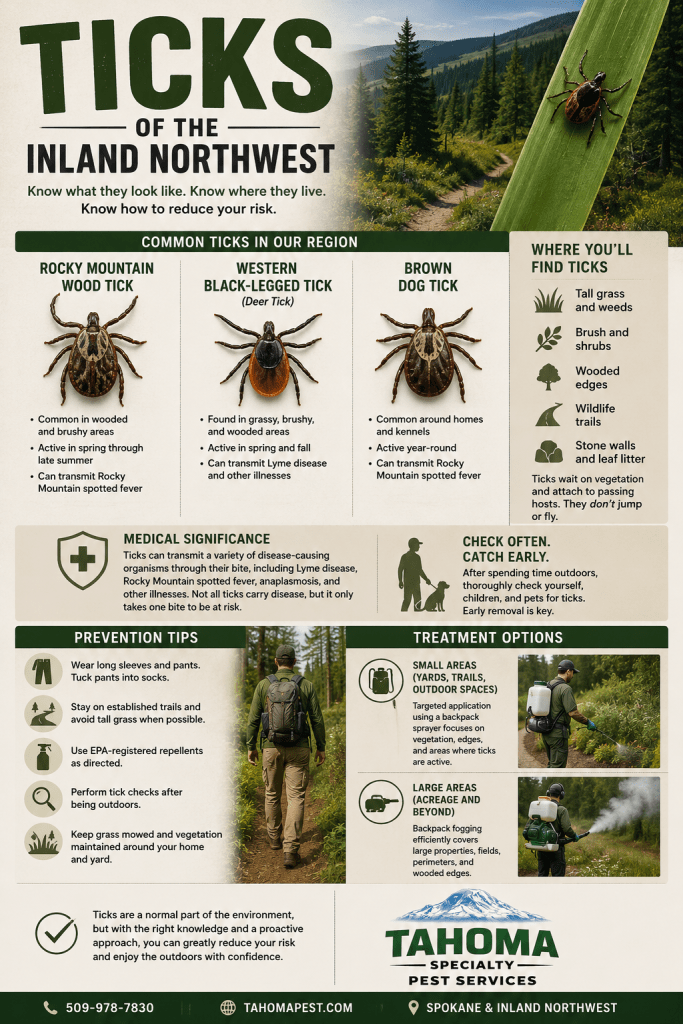
As the weather warms up, people spend more time hiking, camping, working outdoors, and enjoying their property.
It’s also the time of year when ticks become more active.
Ticks are commonly found in:
-tall grass
-brushy areas
-wooded edges
-overgrown vegetation
-wildlife travel corridors
Contrary to popular belief, ticks don’t jump or fly. They wait on vegetation and grab onto passing animals or people as they move through an area.
Several tick species can be found throughout Washington and the Inland Northwest. While most tick bites are little more than an unpleasant nuisance, ticks are medically significant because they can transmit disease-causing organisms through their bite.
Fortunately, the risk can be greatly reduced through awareness and prevention.
A few simple steps include:
-staying on established trails
-avoiding tall grass when possible
-wearing long pants and light-colored clothing
-performing tick checks after spending time outdoors
-keeping vegetation around homes and recreational areas maintained
For properties with persistent tick activity, treatment can also be very effective.
For smaller areas, I typically apply a targeted treatment using a backpack sprayer. Larger properties, such as acreages, may be treated using a backpack fogger to efficiently cover broader areas where ticks are active.
Treatment focuses on vegetation, edge habitat, travel corridors, and the places ticks are most likely to be encountered.
Like many pest issues, the goal isn’t simply to react to a problem after it occurs. It’s to reduce the likelihood of encountering one in the first place.
Tahoma Specialty Pest Services
509-978-7830
tahomapest.com

